Every office worker with lower back pain knows this moment.
The stand-up.
The meeting ends. Or the phone rings. Or the clock says 5pm andyou need to leave. Whatever the reason, you have to stand up from your chair.
And you brace.
Your hands grip the armrests. Your core tightens. You push upward and your lower back reminds you how long you have been sitting. You straighten slowly.trying not to let anyone notice
You take those few steps stiff, careful and uncomfortable, as your body adjust from hours of sitting to movement.
The stand-up at the morning meeting. The stand-up after the 2-hour client call. The stand-up at the end of the day when you walk to the car park moving like a man 30 years older than you are. The stand-up when you get home and your 3-year-old runs to greet you and you cannot bend to pick her up because your spine is still locked from 9 hours of sitting.
You are 38. You stand up like you are 68. And nobody has told you why the pain keeps getting worse, or what to do about it beyond relying on pain medication when the pain peaks
If standing up has become something you dread, if your lower-back discomfort gets worse after hours at your desk, if bending to pick up your child has become difficult, or if you feel stiff and uncomfortable every time you leave your chair, keep reading.
YES- GIVE ME THE 21- DAY RESET SYSTEMMy name is Chidi. I'm 38. I live in Lagos. I work in financial services,and like many office workers, i spend long hours sitting at my desk and dealing with Lagos traffic .

For 3 years my lower-back pain affected how I worked, moved, and even interacted with my family. I tried pain medications , physiotherapy, and an ergonomic chair, but the relief never lasted, I eventually realized that managing the pain wasn't enoughI needed to change the habits and movement patterns that were keeping my back under constant strain.
The Presentation Where My MD Watched Me Stand Up
February 2026. Quarterly review meeting. I had prepared a 15-minute presentation on our portfolio performance. My numbers were solid. My confidence was high.
Then I had to stand from the conference chair and walk to the front of the room.
I gripped the armrests. Pushed up. My lower back seized for a moment. I straightened slowly,then walked to the screen trying to make sure no one noticed.
My MD noticed.
I delivered the presentation well. But on the drive home through Lagos traffic I replayed that moment At 38, I am struggling to stand from a chair In front of the team I'm supposed to lead.
That evening I tried to pick up my daughter and my back spasmed and I had to put her down.
That was the moment I stopped asking, "How do I manage the pain?"and started asking , "why isn't this getting fixed".
Three Years of Managing Without Fixing
I had tried the usual solutions pain medications, physiotherapy, an ergonomic chair, a back-support belt heat, and online excercises. Some gave temoral relief while others worked for awhile but none adressed the bigger problem. I was spending most of my day sitting, moving poorly and expecting my body to keep coping.
I had spent more than ₦12,000 trying to manage the problem, yet i was still stiff when i stood up. Uncomfortable after long hours at my desk, and afraid to bend or lift my child.
The problem wasn't simply that my back hurts, I had never given a practical system for changing the daily habits and movement patterns contributing to the problem
Total in 3 years: over ₦170,000. Painkillers that mask and damage. Physiotherapy that works in the clinic and fails at the desk. A chair that accommodates weakness. A belt that worsens weakness. Balms that warm temporarily. YouTube videos that demonstrate without structuring. And the stand-up. Still stiff. Still painful. Still 38 going on 68.
The Elder Who Watched Me Walk and Diagnosed the Chair
April 2026. During an Easter visit to my family compound in Anambra. My father's friend, Papa Okechukwu watched me get out of my car after a long drive. At 71, he has spent decades helping people with physical problems.
He watched me get out of the car after the 6-hour drive from Lagos. The stand-up. The grimace. The stiff walk. The hand on the lower back.
"How long has your back been like this?" he asked.
"Three years."
"You sit for work?"
"Nine hours a day."
He nodded slowly.
"Your problem is not your spine. Your spine is fine. Your problem is the muscles that HOLD your spine. When you sit for 9 hours every day, the muscles that support your lower back switch off. They stop firing. They weaken. They shorten. Your spine is left without its support system. When you stand up, those muscles cannot engage fast enough to stabilise the spine. The pain you feel is your spine bearing load that the muscles should be carrying."
"The diclofenac reduces the pain signal. But the muscles are still switched off. The chair supports the spine mechanically. But the muscles are still switched off. The belt holds the spine externally. But the muscles are still switched off. Everything you have tried manages the CONSEQUENCE of switched-off muscles without switching them back ON."
He taught me a method he had developed for modern desk workers whose bodies had adapted to sitting the way a plant adapts to growing in shade: alive, but structurally weakened.
Part 1: The Muscle Reactivation Protocol. Specific exercises — not general "core work" — that target the deep stabiliser muscles (multifidus, transverse abdominis, and pelvic floor) that switch off during prolonged sitting. These muscles are different from the "six-pack" muscles. They are deep, postural, and responsible for spine stability. When they switch off, the spine loses its internal scaffolding. The protocol switches them back on through specific activation sequences done in 10 minutes daily. No gym. No equipment. At your desk.
Part 2: The Anti-Inflammatory Spine Preparation. A traditional preparation using natural market ingredients that reduces the chronic inflammation in the lower back muscles and joints. The sitting position creates constant compression in the L4-L5 region. This compression produces chronic low-grade inflammation that painkillers mask but do not resolve. The preparation addresses the inflammation from below, supporting tissue recovery alongside the muscle reactivation.
Part 3: The Movement Reset. The specific daily movement patterns — morning, midday, and evening — that prevent the muscles from switching off during the sitting day. Not a gym programme. Not a workout. Micro-movements integrated into your desk routine that keep the stabiliser muscles firing throughout the day. The movement reset takes 2 minutes at each interval and can be done at your desk without anyone noticing.
"21 days," he said. "The muscles that have been switched off for 3 years don't reactivate overnight. But neural reactivation begins within the first week. By Day 7, the stand-up will be slightly less painful. By Day 14, the stiffness will reduce noticeably. By Day 21, you will stand from your chair without the grimace. Without the bracing. Without the stiff walk. Because the muscles will be holding your spine the way they were designed to."
YES- GIVE ME THE 21-DAY RESET SYSTEMDays 1-5: The Same Stiff Stand-Up
I started on a Monday. Muscle reactivation protocol: 10 minutes before work. Anti-inflammatory preparation: twice daily. Movement reset: 2-minute micro-sessions at 10am, 1pm, and 4pm at my desk.
Day 3: stand-up after the 2pm meeting. Same grimace. Same stiffness. Same 3 careful steps.
Day 5: I stood in my office doing the activation exercises and thought: "An old man in Anambra has given me 10 minutes of exercises and told me to drink a preparation twice a day. I've already spent ₦170,000. How is this going to fix what an ₦85,000 chair and ₦72,000 of physiotherapy couldn't?"
Papa Okechukwu's voice: "The muscles have been switched off for 3 years. The neural pathways that activate them have weakened. You are rebuilding those pathways now. The exercises feel like nothing because the muscles are barely firing. By Day 7, the firing increases. By Day 10, you will notice the stand-up is slightly less dramatic. Not painless. Less dramatic. The drama reduces because the muscles are beginning to catch the spine."
I continued.
Day 8: The Stand-Up Was Different
Monday morning meeting. The meeting ended. I stood up.
No grimace.
Not painless. But the sharp seize that normally accompanied the first 2 seconds of standing was absent. I stood up and my lower back complained — but it didn't seize. The muscles were catching the spine, partially, for the first time in 3 years.
Day 12: the 3pm pain peak was noticeably lower. I reached for the diclofenac out of habit, then paused. The pain was present but manageable without it. I didn't take it. First afternoon without diclofenac in 2 years.
Day 14: stand-up after a 3-hour session. No grimace. No brace. I stood up and walked. Normally. My colleague said: "You seem lighter today." She didn't know what she was observing. She was observing a man whose stabiliser muscles were beginning to hold.
Day 21: I Picked Up My Daughter
A Saturday morning. Adaeze ran to me in the kitchen. "Daddy, carry me." The same request I had been failing for months.
I bent. Picked her up. Lifted her to my hip. Held her there.
My lower back was present. Not painful. Not seizing. Not protesting. Just present. The way a healthy lower back is present: aware of load, managing it, stable.
I held my daughter and stood in the kitchen and felt something I hadn't felt in 3 years: trust. Trust in my own spine. Trust that my body could do the things a 38-year-old body is supposed to do: stand from a chair, bend to a child, walk without stiffness, sit without building toward pain.
My daughter said "Daddy, you carried me!" with the surprise of a child who had been hearing "Daddy can't right now" for months. I carried her. Not because the pain disappeared. Because the muscles that hold my spine finally woke up. And a held spine is a stable spine. And a stable spine carries a child without seizing.
What Changed Beyond the Spine
The diclofenac. I stopped taking it daily. From daily at 3pm to once a week, maybe, after an exceptionally long sitting day. The ₦6,000-₦18,000/year on painkillers is gone. My gastroenterologist no longer worries about NSAID damage to my stomach lining.
The stand-up. I stand from my chair now the way a 38-year-old should: fluidly, without bracing, without grimacing, without the stiff walk that made my team see me as physically compromised. The stand-up is no longer a moment. It's just standing up.
The drive home. Lagos traffic used to be 2-3 hours of escalating pain. By Lekki toll gate, my back was on fire. Now, with the movement reset done at 4pm before leaving the office, the drive home is uncomfortable but not painful. The muscles hold through the traffic because they were fired before the drive began.
The presentation. I presented at the Q2 review last month. Stood from the conference chair. Walked to the screen. My MD was there. He noticed nothing. Because there was nothing to notice. A man standing up from a chair. Normally. As it should be.
I Wasn't the Only One
My colleague Bola. 42. HR manager. "Chidi, I had been doing YouTube exercise videos for a year. None of them explained that the specific muscles causing my pain were the DEEP stabilisers, not my abs. The reactivation protocol targeted the right muscles. By Day 14, the pain during my morning commute had halved. By Day 21, I stopped carrying Voltaren gel in my bag."
My friend Emeka. 35. Software developer. "I spent ₦120,000 on an ergonomic standing desk setup thinking standing was the answer. Standing without strong stabiliser muscles just moved the pain from sitting to standing. The protocol strengthened the muscles. Now I can sit OR stand without pain. The desk was irrelevant. The muscles were everything."
Same method. Different jobs. Different chairs. Different ages. Same result: the stabiliser muscles reactivate, the spine regains its internal scaffolding, and the stand-up stops being the moment you dread. Not managed. Fixed.
Why I'm Sharing This
After my recovery, I asked Papa Okechukwu's permission to document his method. "Papa, there are people taking diclofenac every afternoon and damaging their stomachs. People who spent ₦85,000 on ergonomic chairs that accommodate weakness. People standing up from their desks like old men at 35. People who cannot pick up their children. Can I write this down?"
He agreed. "Tell them: the spine is not the problem. The muscles that hold the spine are the problem. Switch the muscles back on and the spine holds itself. And tell them: no painkiller switches on a muscle. No chair switches on a muscle. Only the correct activation exercise, consistently practised, switches on a muscle. 21 days."
BackWise -The 21-Day Office Worker's Reset System
The BackWise 21-Day Reset for Calming Lower Back Pain From Sitting
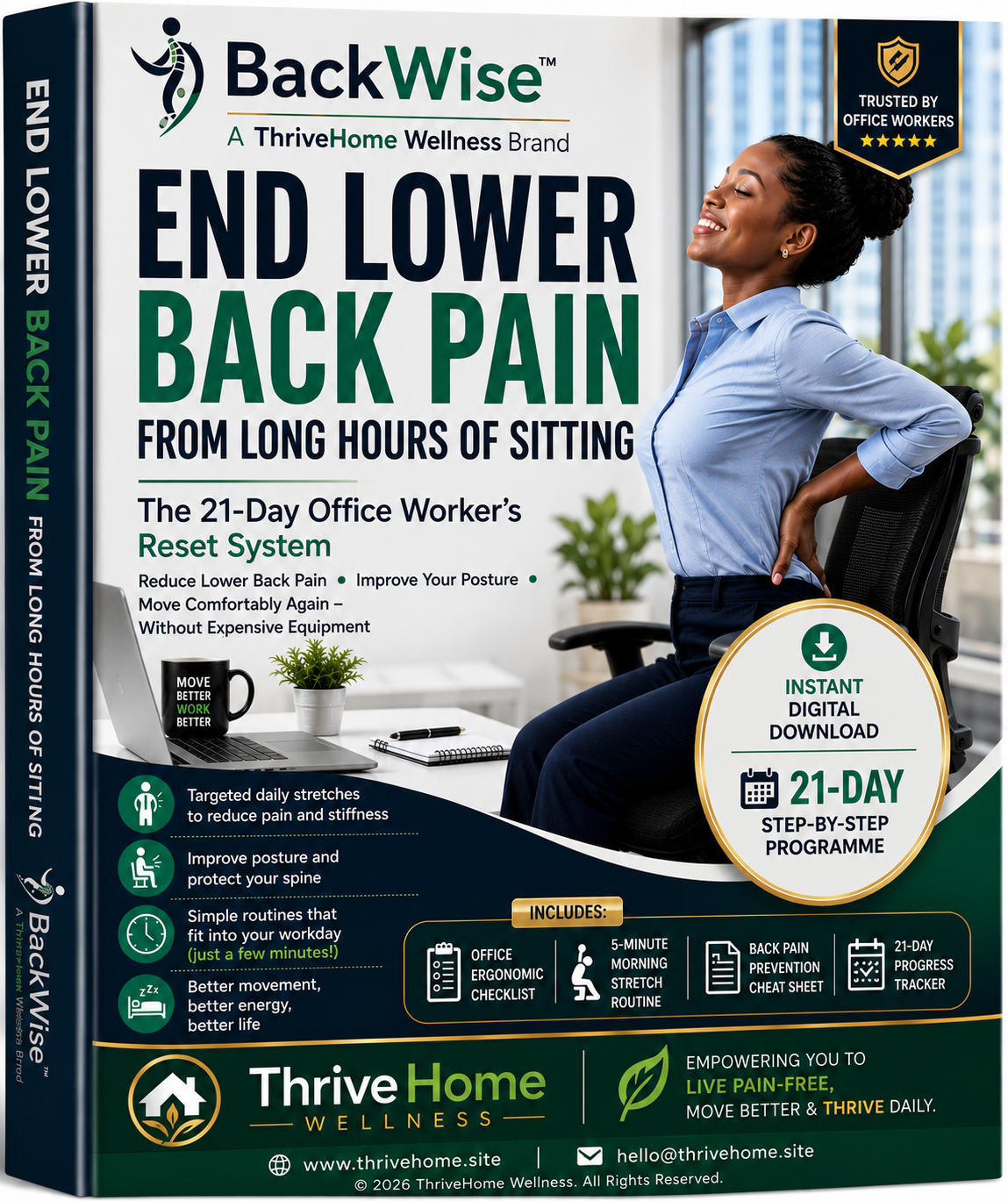
Switch the muscles back on.Calm the pain. Strenghten Your Spine
What Other Nigerians Are Saying
"4 years of YouTube exercise videos. None targeted the deep stabilisers. The reactivation protocol identified the RIGHT muscles and taught me to fire them correctly. By Day 14, my morning commute pain halved. By Day 21, I stopped carrying Voltaren gel in my bag. The specific muscle targeting made the difference no general exercise video could."
"Spent ₦120,000 on a standing desk thinking standing was the answer. Standing without strong stabiliser muscles just moved the pain. The protocol strengthened the muscles. Now I sit or stand without pain. The desk was irrelevant. The muscles were everything."
"Post-pregnancy back pain that never fully resolved, then worsened by 8 years of desk work. My physiotherapist gave me exercises I couldn't sustain. Papa Okechukwu's protocol built the exercises into my work schedule. 10 minutes before work, 2-minute resets at my desk. Sustainable. By Day 18, I stood from the boardroom chair without the involuntary hand-on-hip gesture my colleagues had stopped commenting on."
"5 years of daily diclofenac. My gastroenterologist warned me about stomach lining damage. But without the painkiller, I couldn't sit through a 3-hour case review. The protocol addressed the CAUSE not the symptom. By Day 14, I stopped the daily diclofenac. By Day 21, I only took it after exceptionally long court sessions. My gastroenterologist said my stomach lining risk had reduced significantly."
"Ergonomic chair: ₦85,000. Lumbar cushion: ₦8,000. Back support belt: ₦6,000. Wrist rest, monitor arm, footrest: ₦25,000. Total ergonomic spend: ₦124,000. The pain continued because every piece of equipment was doing the work my muscles should have been doing. 21 days of the reactivation protocol and the ₦124,000 of equipment became what it always should have been: nice to have, not medically necessary."
"NHS referral to physiotherapy: 4-month wait. When I finally attended, 3 sessions and a leaflet. Same as every other story. Papa Okechukwu's protocol gave me the structured programme the NHS couldn't. 10 minutes daily, at my home office desk. By Day 21, the lower back stiffness that had been my companion for 6 years was manageable for the first time. My GP noticed improved posture at my next appointment."
Main Method: ₦25,000 value
Bonus #1 (10-Minute Daily Reset): ₦8,000
Bonus #2 (Spine-Calm Food & Posture Guide): ₦8,000
Total Value
₦41,000
You Pay Today
₦9,800
One payment. Lifetime access. No gym. No equipment. At your desk. 21 days.
Instant download • Both guides included • 21-day guarantee • No gym required
Plus: 2 Essential Guides
🦴 BONUS #1: The BackWise 10-Minute Daily Reset
(₦8,000 Value. Yours FREE)
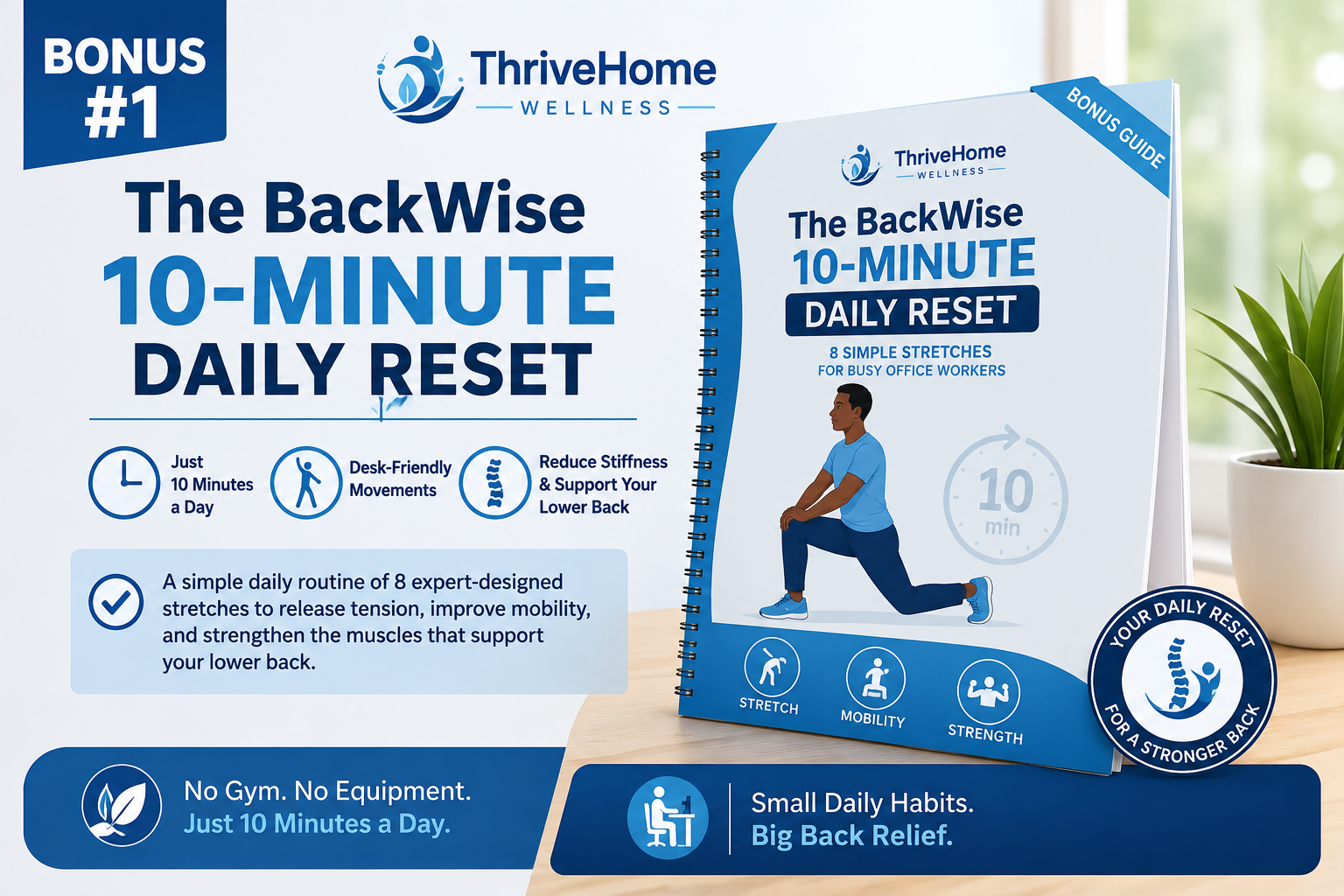
A simple 10-minute daily reset designed for busy office workers. Follow easy, desk-friendly movements that help reduce stiffness, restore mobility, and strenghten the muscles that support your lower back. No gym. No equipment. Just 10 minutes a day
🦴 BONUS #2:The BackWise Food and Posture Guide
(₦8,000 Value. Yours FREE)
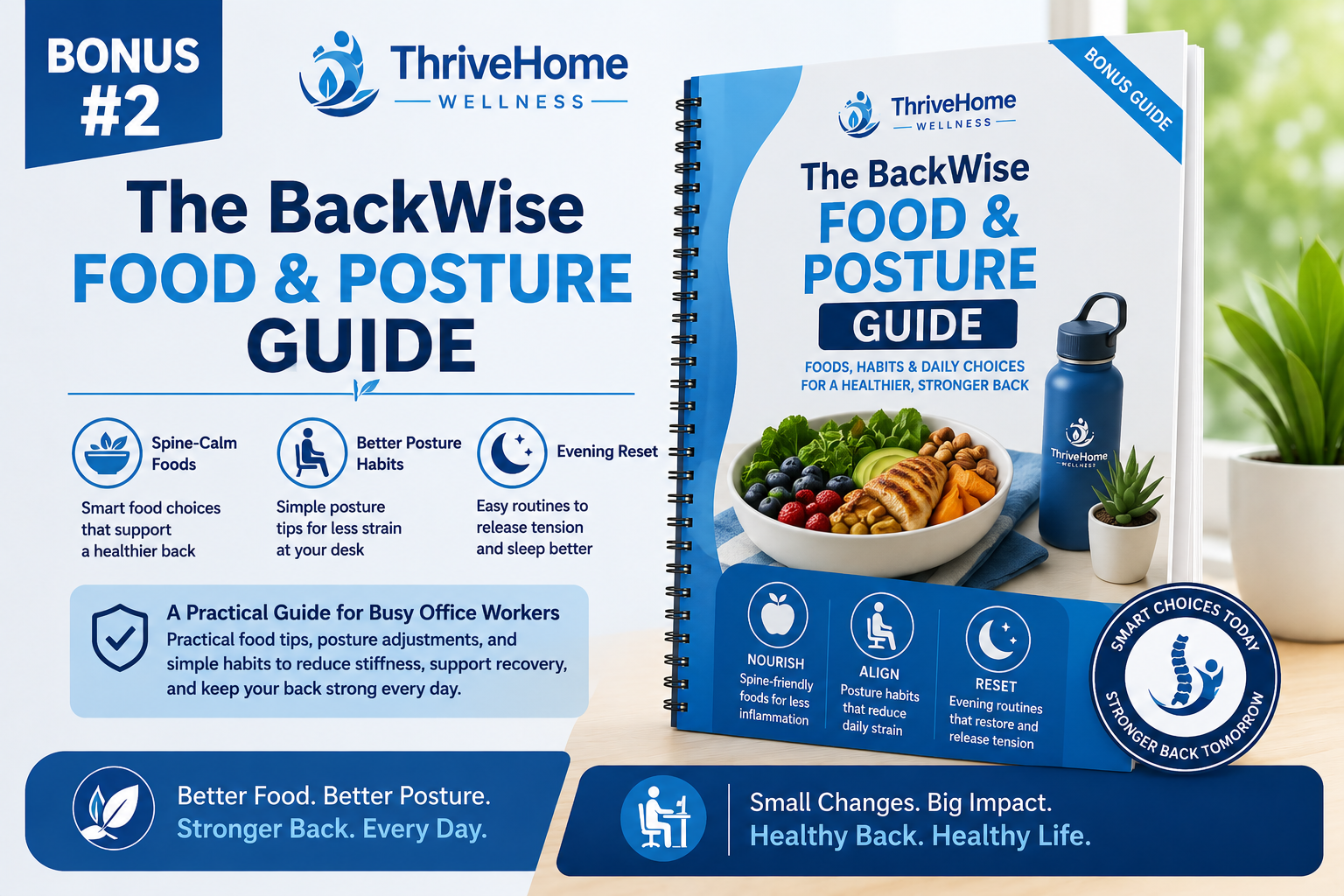
A practical Guide to everyday foods and simple posture habits that supports a healthier back. Learn how to make smarter food choices, improve your sitting position, adjust your workstation, and use a simple evening reset to ease the stiffness that build up after long hours at your desk. Designed for busy office workers with practical tips that you can start using imediately.
21-Day Conditional Guarantee
Follow the BackWise method consistently for 21 Days and give your body a fair chance to respond. If you dont experience any meaningful improvements in your everyday comfort, movement, or ease of standing, you can request a refund according to the guarantee terms.
You keep both BackWise guides even if you requested a refund.
Try BackWise for 21 Days. Follow the system. Feel the difference
Right Now, You Have a Choice
Another afternoon spent managing the pain without adressing the habits and patterns behind it.
Another stand-up where you notice yourself still moving carefully
Another evening where your lower back keeps you from fully enjoying time with the people you love
Another ₦85,000 on equipmen or quick fixes - without changing the everyday habits that may be keeping the problem going. You dont need another temporary fix you need a better daily system
Your chair can support you, but it cannot replace movement. Pain relief can help you feel better, but lasting improvements also require consistent habits and appropriate exercises. The goal is to help you build the strenght, mobility and movement habits that supports your lower back.
Imagine 21 days from now:
You stand from your chair. Fluidly. Without bracing.
Your daughter says "carry me." You carry her.
You rely less on temporal pain relief to get through the day.
You present to your MD and the stand-up is invisible.
₦9,800. 21 days. 10 minutes/day.Build the strenght, mobility and movement habits that supports your lower back. Stand, move and work with greater confidence.
P.S. #1: What will the stand-up look like at 5pm today? The same stiffness? The same careful movement? ₦9,800 and 21 days of 10-minute daily practice can give you a structured way to start changing your desk-day habits
P.S. #2: You dont need another complicated routine. The Office Worker Lower Back Reset gives a simple 21-day structure with practical excercises and desk-friendly habits you can follow consistently.
P.S. #3: A simple reminder: your body responds to what you practice consistently. You dont need a complicated routine. Ten focused minuites a day can become a practical reset for the stiffness and discomfort that can build up during long hours at a desk. Start small, stay consistent, and give your lower back the attention it deserves.